The Jeweled Horse: David Webb’s Kingdom in Motion
A Lipizzaner clip-brooch turns equestrian pageantry into a study of movement, costume and graphic surface.
David Webb’s animal jewels are often described through their exuberance, but the more useful distinction is structural: they convert recognizable creatures into tightly controlled arrangements of color, surface and silhouette. The Lipizzaner Horse brooch makes that method unusually clear. Its subject is not a horse observed at rest. It is a horse presented—plumed, bridled and ornamented—so that pageantry becomes part of the anatomy.
David Webb dates the introduction of its Kingdom collection to 1957. That collection-level history places animal imagery at an important point in the house’s postwar vocabulary, although it does not establish the manufacture date of this particular jewel. Auction records give the design a more specific name. Christie’s and Sotheby’s have catalogued exact-design examples as Lipizzaner horse brooches or clip-brooches; a Christie’s record from 2007 described the same composition as a “carnival horse.” Taken together, those descriptions identify a theatrical show horse rather than a naturalistic equestrian study.
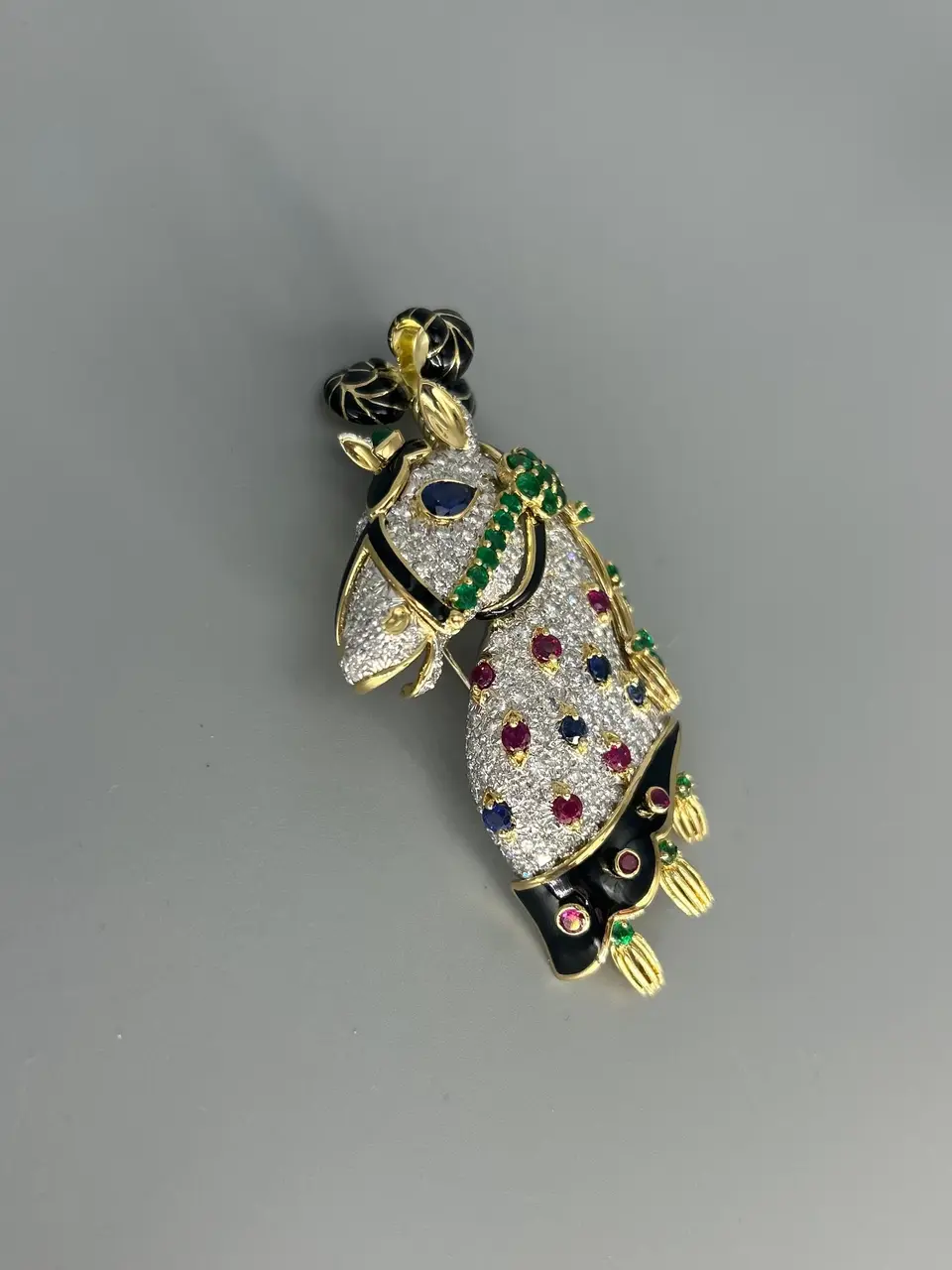
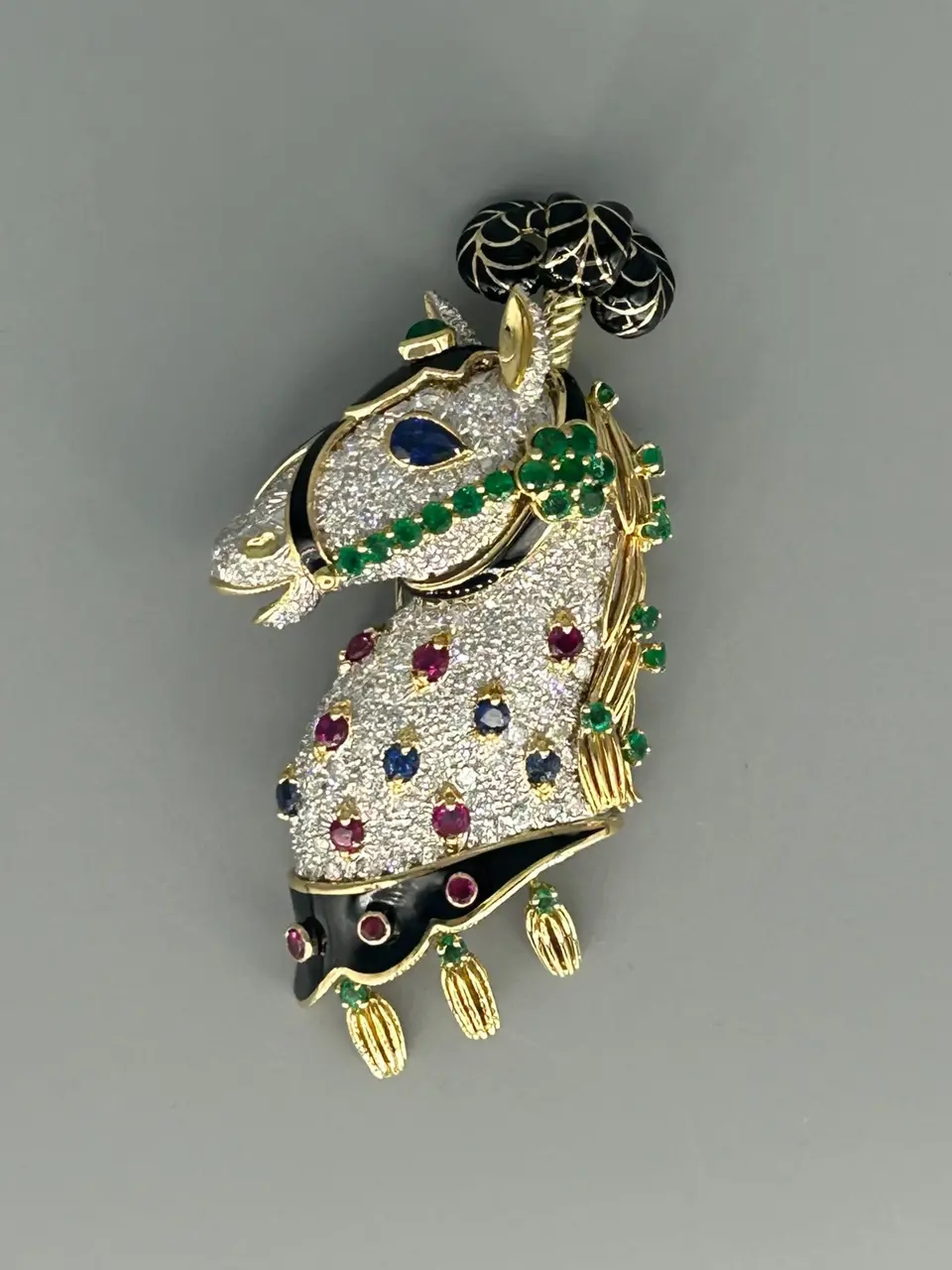
The distinction can be seen in the jewel’s profile. A long plume rises above the head, while tassels and patterned trappings extend below it. These elements break the compact outline and suggest motion without requiring the animal itself to move. The head remains legible in profile, but its harness becomes a second drawing laid over the form: curved bands organize the face, suspended ornaments create rhythm, and the eye serves as a concentrated point of color. The effect is closer to costume or heraldic display than to zoological description.
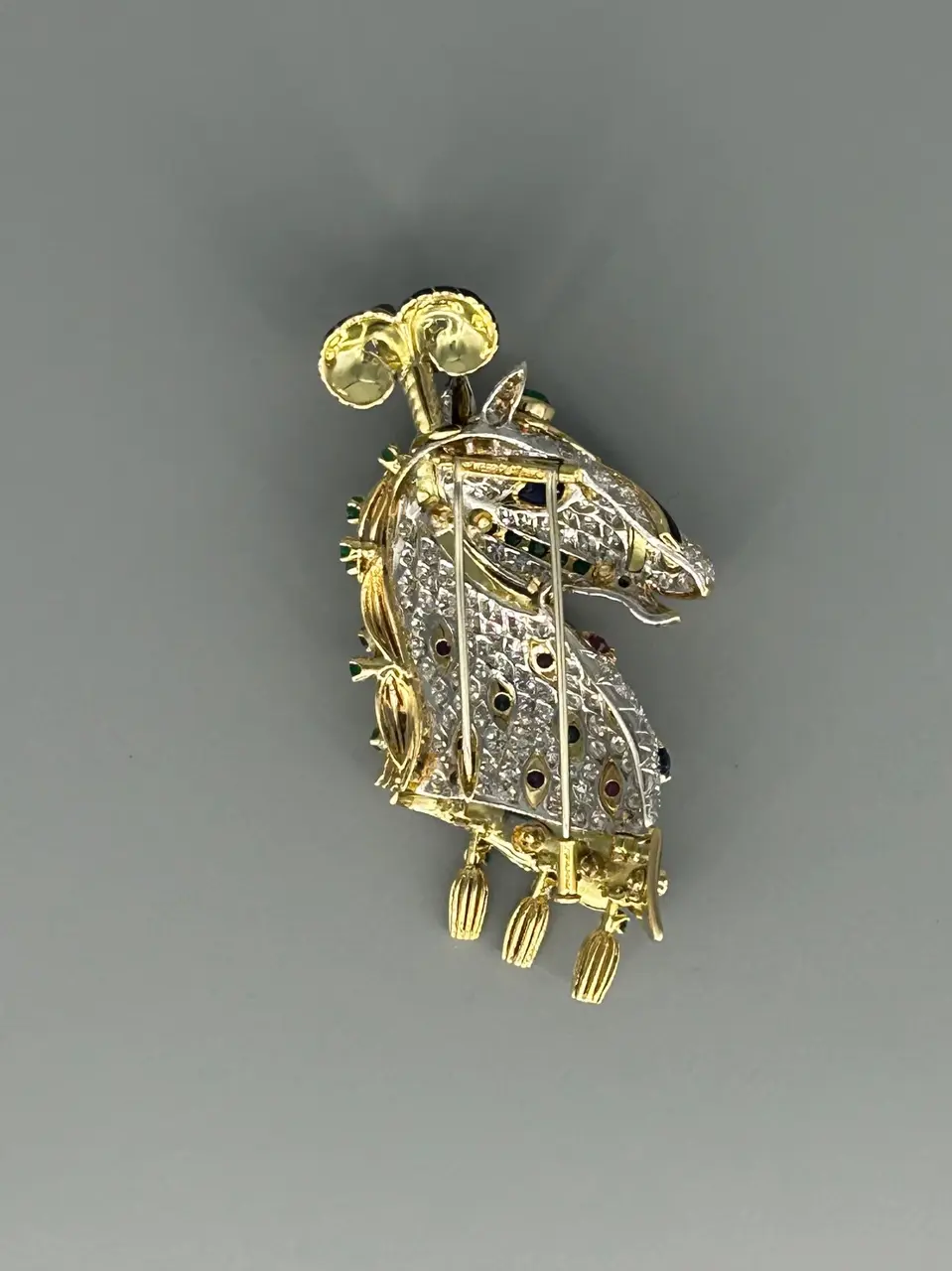
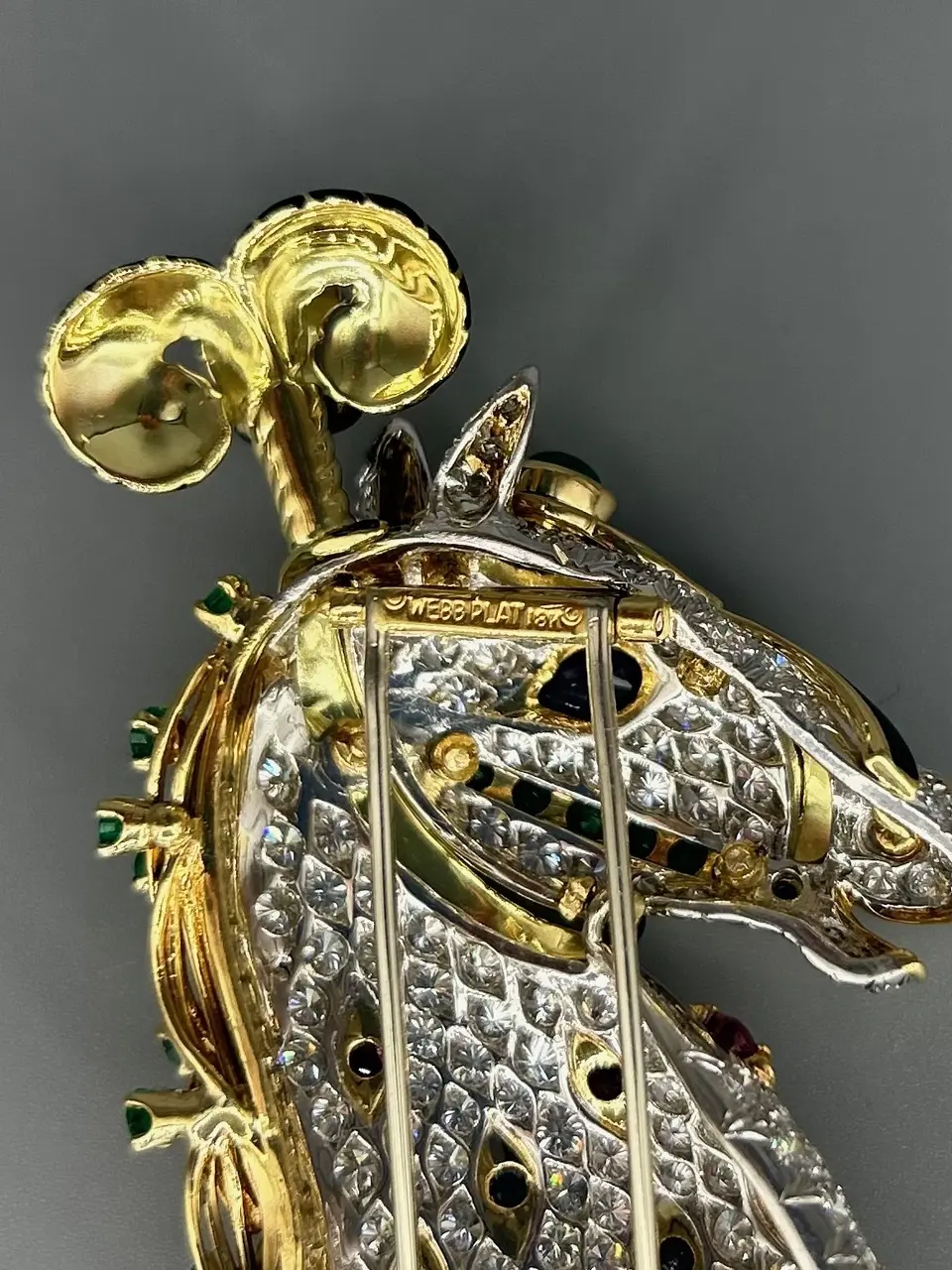
The five VLF photographs support a close reading of that surface. They show pavé-set colorless stones across the head, blue, red and green accents, black enamel, and yellow-gold details. The reverse is signed WEBB and marked PLATINUM. Exact-design auction descriptions identify diamonds, sapphires, rubies and emeralds.
Color is not applied evenly. Black enamel creates graphic separations and gives the bridle visual weight; the colored stones interrupt the pale pavé with small, deliberate accents. Yellow-gold details warm the composition and distinguish the ornamental apparatus from the cooler field of platinum and colorless stones. This contrast allows the jewel to read at two distances. From across a room, plume, profile and saturated accents establish the horse immediately. At close range, the eye follows the harness, tassels and patterned surfaces as a sequence of worked details.
That double reading explains much of the design’s theatricality. Naturalism supplies the recognizable head and alert eye, but ornament controls the character. The Lipizzaner association evokes trained display and ceremonial movement; the jewel does not document a particular animal or performance. Instead, it compresses those associations into pose, costume and surface. The brooch’s sense of motion comes from asymmetry and directional detail: the plume rises, the profile advances, and the tassels pull downward, setting up tension across a small object.
The design’s recurrence in auction records—Christie’s in 2007 and 2026, and Sotheby’s in 2024—supports its identification within Webb’s animal vocabulary. Those records are useful as design evidence, not as provenance for VLF-0102, and they do not determine this jewel’s exact date. What they do show is that the model is recognizable across time and cataloguing contexts.
Within Kingdom, the Lipizzaner horse demonstrates how Webb could make an animal jewel feel animated without surrendering it to literal realism. Anatomy provides the armature; enamel, gemstones and gold turn that armature into ceremony. Its collecting significance lies in that balance: a specific, recurring Webb design in which the animal is inseparable from the spectacle of its presentation.